



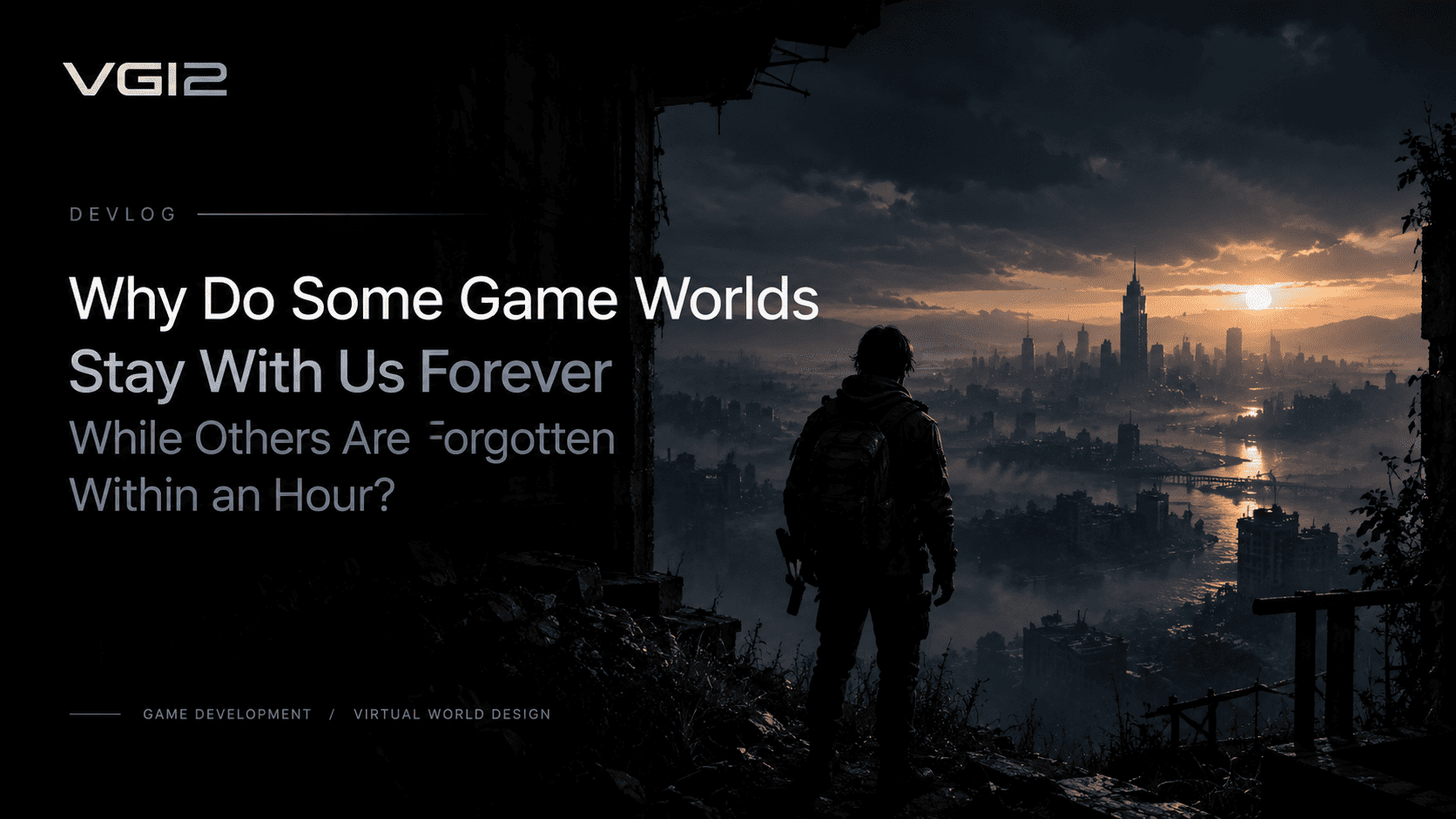
A vast open world is not necessarily a living world. Thousands of buildings, hundreds of miles of roads, and stunning graphics can impress players during the first few minutes. But true immersion begins when players stop noticing the boundaries between gameplay mechanics and the world itself.
Why do we remember the abandoned streets of certain games, spend hours exploring the ruins of others, yet quickly grow tired of enormous maps filled with repetitive missions?
The answer lies not only in technology. Atmosphere, attention to detail, and the feeling that every location has its own story make all the difference.
The World Should Exist Without the Player
One of the secrets behind a convincing game world is the feeling that events took place long before the protagonist arrived.
An old gas station with shattered windows becomes far more interesting when a damaged car sits nearby, an unfolded map lies on the counter, and signs of a hurried escape can be found behind the door. Players begin asking questions. Who was here? Why did they leave? What happened in the final moments before the disaster?
Developers do not have to answer every question directly. Sometimes, the environment itself can tell a more powerful story than a lengthy dialogue or cinematic sequence.
This approach is known as environmental storytelling — conveying narrative through the surroundings. It is particularly effective in games where exploration is an essential part of the experience.
Details Matter More Than Scale
The gaming industry has long been tempted to measure the quality of an open world by its size. Yet expanding a map does not automatically make a game more interesting.
Imagine two districts in the same city.
The first covers several square miles but consists mostly of identical buildings, empty parking lots, and repetitive scenery.
The second is considerably smaller. It features a 24-hour convenience store, a closed school, a residential building with a light burning on the top floor, a billboard advertising a company that no longer exists, and an alley where someone has built an improvised shelter.
The second district may be far more memorable.
The reason is simple: players are given more than space to travel through. They are given reasons to explore.
When creating a game world, developers should therefore think beyond the number of objects. Every significant environmental element should serve a purpose: reinforce the atmosphere, help players navigate, tell a story, or create an interesting gameplay situation.
Sound Is the Invisible Part of Graphics
Players might not notice a subtle change in lighting, but they will certainly feel it when familiar ambient sounds suddenly disappear.
The hum of an air conditioner in an empty shopping mall, the creak of a metal door, a distant siren, or the wind moving between buildings — all these sounds help establish a sense of place.
Contrast can be especially powerful.
On a busy street, the surrounding noise creates the impression of normal life. But once the character enters an abandoned building, footsteps begin echoing through the corridors, and every unexpected sound becomes significant.
In horror games and post-apocalyptic adventures, silence can be just as expressive as a musical score.
That is why sound should be designed alongside the level itself, rather than added at the very end of development.
Performance Is Part of Game Design
Modern engines make it possible to create incredibly detailed environments with sophisticated lighting, expansive landscapes, and thousands of objects. However, every technical feature comes at a cost.
This becomes especially noticeable in open-world games. Dense vegetation, dynamic shadows, translucent effects, high-resolution materials, and complex lighting systems can significantly increase hardware demands.
Yet greater detail does not always translate into a noticeably better experience.
Smart use of levels of detail (LOD), draw distances, instancing, world streaming, and optimized materials can preserve visual richness without constantly raising system requirements.
Art direction matters, too. Fog can obscure distant objects, thoughtful composition can guide the player’s attention, and carefully placed light sources can make a scene more expressive without requiring excessive detail.
Good optimization is not merely a technical limitation. It is part of the art of making games.
Why Players Need to Feel Alone
In some games, the absence of characters and events feels like a weakness. In others, it becomes the foundation of the atmosphere.
An empty street after a catastrophe can evoke stronger emotions than an arena full of enemies. A destroyed family home can tell a more compelling story than a dozen journal entries. A distant silhouette on the horizon can inspire more curiosity than a quest marker.
But solitude only works when the world does not feel artificially empty.
Players need to believe that something exists beyond what they can currently see: other districts, unknown people, forgotten events, or dangers they have yet to encounter.
The combination of uncertainty and believability is what transforms exploration into a reward in its own right.
The Future of Game Worlds Is About More Than Technology
Graphics technology will continue to advance. Worlds will become more detailed, lighting more realistic, and development tools more accessible.
However, technological progress does not replace the fundamental principles of game design.
Players still need curiosity, emotional connection, a sense of agency, and reasons to keep moving forward. Even the most realistic virtual city remains little more than a backdrop if there is nothing meaningful to discover.
At VGI2, we believe that a compelling game world does not begin with polygon counts or map size. It begins with an idea the developer wants to communicate to the player.
Sometimes, all it takes is a single empty room, an open window, and a sound coming from the darkness.
Because the best game worlds are not simply the ones that look real. They are the ones we want to believe in.
VGI2 — An independent perspective on game development, technology, and the future of interactive worlds.
Leave a Reply